The MOOC on
current/future state of higher education started with presenting two current
trends that were said to be opposing: there's a need for bigger and better universities but for
smaller costs.
Without
profound changes they are of course incompatible. It's like Encyclopedia
Britannica would have wanted to double its volume (or amount of sold books)
without adding costs. We know how the story wound up.
There are
several thousand classmates attending this CFHE12 course. Input-wise: so far so
good. How about quality of learning? How about dropouts? If there are enough (and free) raw materials to be spared, does it matter in the end of the production line?
The fundamentals
of higher education lay on hierarchies. Now, the model of crowd-sourcing
knowledge like Wikipedia did is a very different one.
What would
a university be like, if it was not based on line organization but on something
else, like matrix organization or perhaps a neural network? Would that change the way you defined "higher" education?
Last week's Friday afternoon at InnoOmnia, Espoo. Small groups of adult students wandering around the vocational institute. They had gotten keys to access almost any space to watch and observe, to ask and interview, to learn and to get a grip on the community.
These teacher trainees were on Edutech bootcamp, a part of their vocational teachers' pedagogical studies. They had been learning education technology and pedagogy for two days, and this was their concluding task.
The trainees formed groups of three, got a key and an iPad, and started by consulting the course blog about what does "community of practice" mean, how can it be used as a support in learning, and what they are exactly expected to dig out in their own task.
There were two questions the students had to find answers for:
How do CoP principles show up in InnoOmnia?
How does technology support the CoP in InnoOmnia?
By letting the students do their learning in an authentic context, by letting them decide over their task management themselves we wanted to get them engaged, and to take the ownership of their own learning. By making them to analyze and evaluate InnoOmnia's practices and to create an unconventional learning outcome, we wanted them to use also their higher-level thinking skills (as they are classified in Bloom's taxonomy).
As their just-started studies are mainly carried out as distance learning, by such a procedure we wanted to support the creation of their own common practices, and their own community of practice.
Three groups interviewed students, entrepreneurs and teachers in InnoOmnia on video (above and eg. this and this). One group took pictures and made blog entries, another a Facebook page, and yet another a comic strip.
Further reading on communities of practice in education and on using technology to support them:
Barab, S. A., & Duffy, T. (2012). From Practice Fields to Communities of Practice. In D. Jonassen & S. M. Land (Eds.), Theoretical Foundations of Learning Environments (2nd ed., pp. 29–65).
Hoadley, C. (2012). What is a Community of Practice and How Can We Support It? In Theoretical Foundations of Learning Environments, see above (pp. 286–299).
Lankshear, C., & Knobel, M. (2011). New Literacies: Everyday Practices and Social Learning (3rd ed.). See example pp. 232-245.
Lloyd, A. (2010). Lessons from the workplace: Understanding information literacy as practice. In Practising Information Literacy: Bringing Theories of Learning, Practice and Information Literacy Together (pp. 29–50).
Recently, I've read from many sources how 'learning to be', to become a full member
or participant in the field, is so essential in one's learning. In New Literacies (3rd ed) Colin Lankshear and
Michel Knobel tell a story about Tabby Lou, spelled out originally by Elizabeth
Hayes & James Gee.
Tabby – game-playing grandma turned into a Sims designer
Tabby is a grandmother with a health issue that confine her to
home. She then learns to play The Sims with her grandchildren. One of those said
she'd like a purple potty for her Sims house, and Tabby decided she would
create one.
Tabby did find tools for doing the job, but couldn't
understand how to use them. Gradually she got help, learned more, got in
contact with designers, and after all, became a Sims designer herself, too.
There's a genuine Tabby pot above. Not the pot, but a later production among her approx. 9,000 (!) creations.
"Yeah, I am in my 62nd year on this earth. Wow!! Didn't think I'd make it
this far. AND, I hit 6 and a half million downloads on my Birthday, How Cool is
that!" (from Tabby's page)
What a nice story about "learning to be", about
becoming a member "in a community in which expert practices are central", like Chistopher Hoadley puts it in his article 'What is a Community of Practice and
How Can We Support It?', here.
This has a lot to do with media education
Of course the community of practice can be put at work to
support learning. And of course passion, engagement, community, and technology can be harnessed for this purpose.
Some tested and tried methods that Hoadley calls C4P: Linking people with others with similar practices and
interests. Facebook pages. Sharing
resources and information. Wikis like OpiToinenElämä. Tools for
communication and discussion. BBS, chat, Skype, virtual world... you name it...
Meta-level mechanisms showing twhat others are doing or what they've done. Wiki
history, Amazon recommendations.
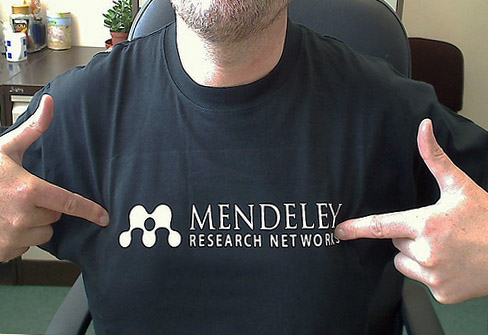
Dear Reader, may I introduce: This is Mendeley, my friend. We co-operate daily nowadays, as I've got three research papers in the works at the same time.
Mendeley is a great application for managing and sharing research papers. On a computer the desktop application hogs all your article pdf files in drag-and-drop style, and extracts the metadata automatically. All my data is stored in the cloud, so I can access it anywhere.
Mendeley is such a treasure, that I even ended hostilities with MS Word and returned using it for writing my papers. There's a handy plug-in for Word, and whenever I need a citation, I select the plug-in which opens a pop-up window, start writing the title/author name, and there I'll have it. It is pasted in the right place, formatted just the way I need (APA, in this case).
Getting the reference done couldn't be easier: articles, books, web pages... Mendeley scans my text, knows what citations have been added, and makes the Bibliography section in a snap. Pure APA-style, hassle-free. Wow!
I can also read and annotate those pdf-based articles in Mendeley – also on my iPad.
Like a true friend, Mendeley doesn't charge for it's services. The free account holds for 2 Gb data, and I've used only 42 Mb.
One thing that I'd like my friend to learn: to accept bar code or ISBN when adding a book. Nowadays I must type every field manually. There are already many handy apps for iPad that make adding books as effortless as Mendeley's pdf process. Hope the folks get this feature right soon.
They say that Mendeley's also for collaborating online. How's that to be done? If you collab in Mendeley, share your secrets.
PS. I robbed AJ Cann's pic, so that's not my beard. Book your time if you want to whip me for that.
Mediakulttuuri kasvattaa ihmisiä kuin itsestään. Tällaisen väitteen pudotteli Juha Suoranta kirjassaan Kasvatus mediakulttuurissa (pdf).
Mihin sitten tarvitaan mediakasvatusta tai uusien lukutaitojen opettamista? Eli sekö siis riittää, että avataan ovi ja astutaan sisään käytäntöyhteisöön?
Juha väitti myös, että sikäli kun ihmiset oppivat erilaisia mediataitoja, voivat he myös kasvattaa medialla ja mediaa. Katsotaan, saa nähdä mitä tapahtuu. Tai ei vain katsota, vaan toimitaan. Tällä ja siihen liittyvillä tulevilla bloggauksilla on nimittäin tarkoitus sorsastaa ja saada yhteistyöllä todistettua, että uusien lukutaitojen omaksuminen on käytäntöyhteisöön astumista. Aika lähellä Juhan pointtia, siis.
Tässä on näillä näkymin edessä ainakin neljä postausta. Meinasin ensin kaataa tähän aloitukseen käsitteenmäärittelyä muutaman liuskan verran, mutta meni omakin naama vihreäksi, joten piirsinkin käsitteistä karttaa. Popplet-tunnarit omaavat kansalaiset voivat vapaasti tuunata tätä alla olevaa (tästä) ja lisätä samalla myös minun ymmärrystäni aiheesta.
Kuten näkyy, en oikein edes tiedä mitä käsitettä pitäisi käyttää. Koska aion seuraavaksi puhua käytäntöyhteisöistä ja siitä, miten samat lainalaisuudet toimivat myös livenä, ei medialukutaito toimi. Sama juttu näiden käsitteiden kanssa, joihin sisältyy "digitaalinen".
Yksi oivallinen lähestymistapa on Howard Rheingoldin "21st century skills = skills+community." Kannattaa katsoa Howardin keynote-esitys Reboot Britain -konferenssista vuodelta 2009.
As the teacher trainees start the Edutech Bootcamp tomorrow, they will participate a course that is both thoroughly planned and quite out of the box.
I'm happy and proud of having a major share of designing and carrying out this course on educational technology. It's not only my work but it also doubles as my advanced practice teaching, it triples as a topic for my seminar work, and furthermore, I'll squeeze my subject didactics coursework out of this.
Currently, I'm doing a seminar work at the Uni of Helsinki about applying a model called "pedagogical infrastructure framework" on our bootcamp. This is what my initial research plan looks like now.
The pedagogical infrastructure framework is elaborated in Minna Lakkala’s thesis. Here in Google Docs you can check out how I've thought we'll apply technological, social, epistemological, and cognitive approaches to the course.